

Streaming has changed the way people watch content — and the way we reach them. Audiences are no longer tied to cable schedules or limited to one screen. They are watching shows, sports and entertainment across smart TVs, phones, tablets and laptops, often on their own time and on their own terms.
That shift has made OTT advertising an important part of a modern media plan. At Amperage, we see OTT advertising as one of the most effective ways to combine the impact of video with the precision of digital targeting. Let’s explore what OTT is, how it works, how it differs from CTV and why we include it in media strategy.
OTT stands for "over-the-top" and refers to content delivered over the internet.
In simple terms, OTT is the streaming content people access through platforms and apps such as Hulu, Peacock, YouTube TV, Disney+, Paramount+ and Amazon Prime. Instead of coming through a cable or satellite box, the content is delivered directly through an internet connection.
For advertisers, OTT creates an opportunity to place video ads within that streaming environment and reach audiences where more of their attention is already going.
OTT advertising works by serving video ads within streamed programming across internet-connected devices.
At Amperage, we primarily recommend FEP, or full episode programming, across mobile, desktop and tablet. Because that inventory is unskippable, it typically delivers high video completion rates, often in the 90% to 95% range. That is one reason OTT works especially well for brands that already have strong video creative and want audiences to actually watch it.
If a client wants pre-roll, we recommend using it in addition to FEP rather than instead of it. Pre-roll is usually skippable, so it often works best in shorter formats and as part of a retargeting strategy.
One of OTT’s biggest advantages is that it goes beyond the broad audience assumptions of traditional TV. Instead of buying only by program or time slot, we can buy based on who the audience is and when they are most relevant to the brand.
OTT also is addressable, which means ads only serve when the target audience is present. That makes it a more efficient way to deliver video messaging to the right household or user.
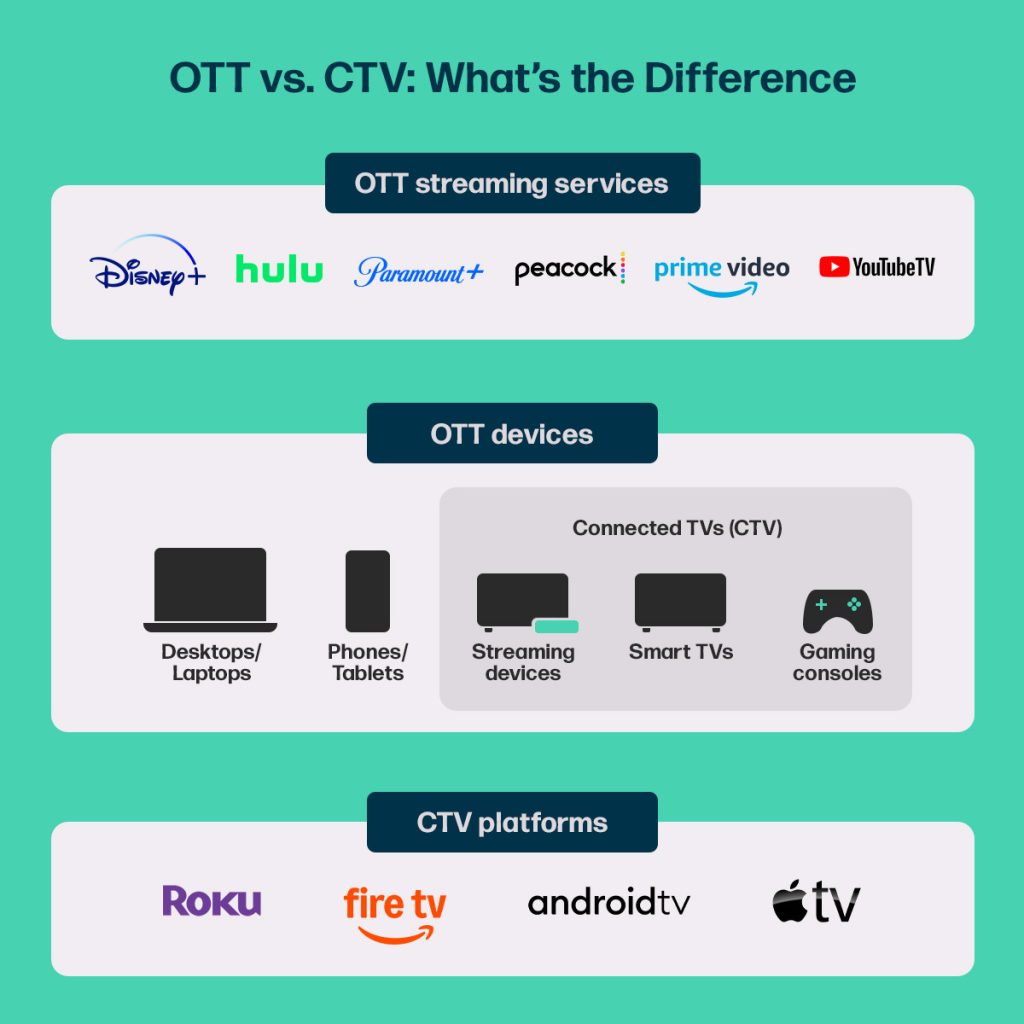
OTT and CTV are closely related, but they are not the same thing.
OTT refers to the way content is delivered (streaming over the internet). CTV, or connected TV, refers to the device used to watch that streaming content on a television screen. That could include a smart TV, Roku, Apple TV, Amazon Fire TV or a gaming console.
So, if I watch Hulu on a smart TV, that is both OTT and CTV. If you watch Hulu on a tablet, laptop or phone, that is still OTT, but it is not CTV.
That distinction matters because media buying strategy, creative execution, targeting and reporting can all vary depending on the device mix and campaign goals.
Depending on campaign goals, we may use behavioral and interest-based targeting, search and purchase intent targeting, and contextual or content-based targeting to help make sure ads reach the right audience.
OTT also supports retargeting and cross-device capabilities. So we can build strategies based on website visits, prior video or OTT ad views and first-party email list matching.
That allows us to reinforce messaging, extend reach and create more strategic sequencing across channels — for example, using OTT to drive awareness and then supporting it with retargeting, paid search, social, display or other channels.
OTT is powerful, but it is not simple. The market is fragmented, inventory quality varies and access to premium placements often depends on the right relationships and buying structure.
That is why having a media partner matters.
At Amperage, we work across multiple vendors to evaluate inventory quality, pricing, targeting options and platform fit. We are not just placing ads. We are helping clients navigate where their audience is, what type of inventory best fits the goal and how to make the budget work as efficiently as possible.
A media partner also helps make OTT more accountable. If you can provide website access, we can offer attribution tracking to better understand how OTT is contributing to outcomes.
We can also report on metrics such as share of available impressions, which helps show whether a budget is sufficient to be competitive and effective in a given market.
That kind of visibility matters because success in OTT is not just about running impressions. It is about understanding whether the campaign has enough scale, whether it is reaching the right audience and whether it is contributing to broader marketing performance.
Bottom line: OTT works best when it is planned strategically. With the right video, the right targeting and the right media partner, it can do more than add impressions to a plan.
If you’re interested in OTT specifically or a strong media strategy broadly, the Amperage media planning & buying team would love to help. Contact us at info@AmperageMarketing.com to get started.
Author Annette Schulte is vice president of marketing & communications with expertise in marketing strategy and messaging built on decades of experience.